OUTDOOR SOLUTIONS

Fencing guide

Which fence is right for you?

Not sure what to ask for? This page explains the main fence types in plain words: what each is good for, what to watch for, and how the cheaper and dearer choices compare.

Cost guide: $$$ lower, $$$ mid-range, $$$ higher, compared with each other. How long a fence lasts depends on the materials, the ground and how it is looked after; the figures here are typical, not a guarantee.

Timber paling fence

$$$

Upright treated pine boards (palings) nailed to three rails between posts. The standard back and side boundary fence across Melbourne.

Good for

  • The lowest upfront cost for a full-height boundary fence
  • Solid privacy at 1.8 m or higher
  • Easy to repair: one damaged paling or rail can be replaced on its own
  • Follows sloping ground well

Things to know

  • Timber shrinks as it dries, so small gaps can open between palings unless they are overlapped
  • Needs to be kept off the soil, or the bottom rots first
  • Fades to grey unless stained or oiled
How long it usually lasts
Commonly 15 to 20 years when built with treated timber and kept clear of soil.
Best suited to
Back and side boundaries where privacy and price matter most.

Picket fence

$$$

Spaced, shaped boards on two rails, usually 0.9 to 1.2 m high. A decorative front fence that marks the boundary without closing the house in.

Good for

  • Adds street appeal and suits most house styles
  • Keeps small children and pets in while staying open and friendly
  • Many picket shapes and spacings to choose from

Things to know

  • Gives little privacy
  • Painted pickets need repainting every few years
  • More timber and more cutting per metre than a paling fence, so it costs more
How long it usually lasts
Commonly 15 to 20 years in treated pine or cypress when kept painted or sealed.
Best suited to
Front yards, where looks matter more than privacy.

Steel panel fence (Colorbond style)

$$$

Solid pre-painted steel sheets held between steel posts and rails. Comes in a range of fixed colours.

Good for

  • Very low maintenance: an occasional hose down
  • Full privacy with no gaps
  • Looks the same on both sides, which neighbours like
  • Quick to install

Things to know

  • Dents are hard to repair: a damaged sheet is usually replaced
  • Can be noisy in strong wind and gets hot in full sun
  • Sloping ground needs stepping or a retaining base
  • Near the coast it needs washing to stop salt damage
How long it usually lasts
Often 20 years or more. It does not rot and is not eaten by termites.
Best suited to
Boundaries where you want privacy with almost no upkeep.

Pool fencing

$$$

A safety barrier around a pool or spa, most often aluminium bars or glass panels with a self-closing, self-latching gate.

Good for

  • Aluminium is the most affordable compliant option and does not rust
  • Glass keeps the view open and makes supervision easier
  • Self-closing gates close behind children on their own

Things to know

  • Pool barriers are covered by law, not just preference: height, gaps, climbable objects nearby and the gate all have rules
  • Glass costs considerably more than aluminium
  • In Victoria, pool and spa barriers must be registered with your council and inspected
How long it usually lasts
Aluminium and glass commonly last 20 years or more. Gate hinges and latches wear and need checking.
Best suited to
Any pool or spa. Ask us what applies to your yard before choosing a style.

Slat or privacy screen

$$$

Horizontal boards with small even gaps, in hardwood such as merbau, treated pine or aluminium. Used as a feature fence, to screen a deck or courtyard, or to hide bins and services.

Good for

  • A modern look that lets air and light through
  • Gap size can be chosen for more or less privacy
  • Aluminium versions need almost no maintenance

Things to know

  • The most timber and labour per metre, so the highest cost
  • Hardwood goes silver-grey unless oiled about once a year
  • Posts need to be closer together to keep long boards straight
How long it usually lasts
Hardwood and aluminium commonly last 20 years or more. Timber needs regular oiling to keep its colour.
Best suited to
Feature areas you look at every day: courtyards, decks, front entries.

Cheaper or dearer?

The choices that change the price, and whether they are worth it

Treated pine or untreated timber?

The cheaper way
Untreated pine costs a little less to buy.
The dearer way
Treated pine has preservative forced into it. “H3” timber is made for use outdoors above the ground (palings and rails). “H4” is made to sit in the ground (posts and sleepers).
Our advice
Untreated pine in the weather or in soil can rot or be eaten by termites within a few years. We use treated timber outdoors, with the right grade for where it sits.
Sleeper (plinth)

A sleeper (plinth) along the bottom, or not?

The cheaper way
Without one, palings run close to the ground. It costs less and is fine on dry, level ground.
The dearer way
A treated sleeper along the bottom keeps the palings off wet soil, closes the gap under the fence for pets, and can hold back a small difference in ground level between you and your neighbour.
Our advice
Worth it where the ground is damp, uneven, or higher on one side, and where dogs dig. It usually adds the most years to a timber fence for the money.
Ground levelConcrete footingPost

Which posts: pine, cypress, hardwood or steel?

The cheaper way
Treated pine posts are the least expensive.
The dearer way
Cypress and hardwood posts are naturally more durable in the ground. Galvanised steel posts cost the most and do not rot at all.
Our advice
Posts are what fail first, because they sit in the ground. Spending a little more on posts is usually the best value in the whole fence. Every post is set in concrete.

Standard palings, or lapped and capped?

The cheaper way
Standard palings sit side by side. As timber dries, thin gaps can appear.
The dearer way
“Lapped” palings overlap, so no gaps open up. A “capped” fence has a rail along the top that protects the cut ends of the palings from rain and gives a finished look.
Our advice
Choose lapped and capped where privacy matters or the fence faces your outdoor living area.
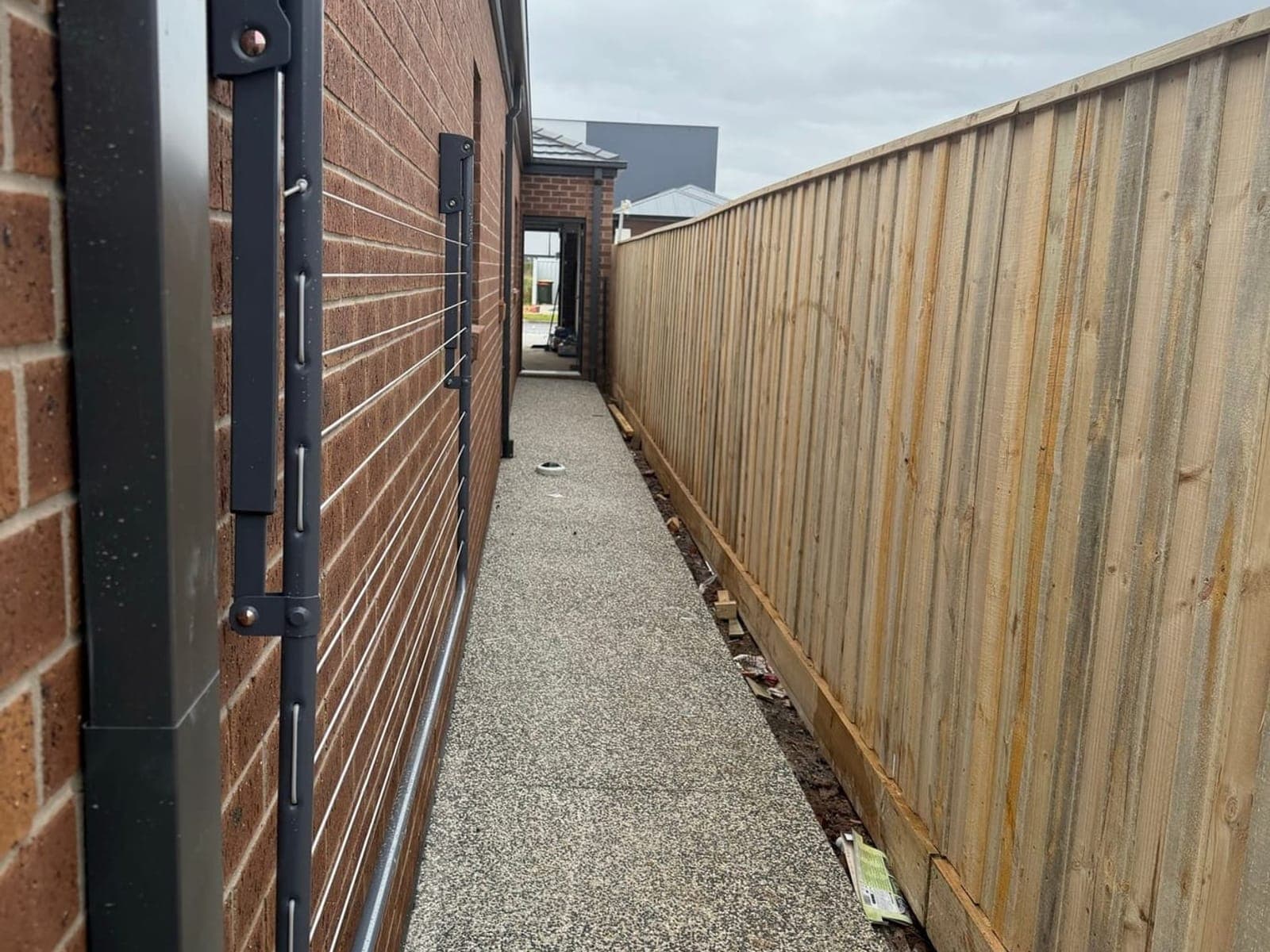
A timber paling fence we built along the side of a house

Looking after it

Three things that make any timber fence last longer

  1. Keep soil and mulch away from the timber. Timber that stays wet rots. Garden beds built up against a fence are the most common cause of early failure.
  2. Seal or oil it. A stain or oil every couple of years slows weathering and keeps the colour.
  3. Fix small things early. A loose paling or a leaning post is cheap to fix when it is one; it costs much more once the fence starts to pull itself over.

Before you order

Six things worth knowing first

  1. 1

    Talk to your neighbour first

    In Victoria, neighbours usually share the cost of a standard dividing fence. Agree on the type, height and cost split before work starts. We can give you a written quote to show them.

  2. 2

    Know where the boundary is

    The fence goes on the title boundary. If the old fence is in the wrong place or the line is unclear, a licensed surveyor can mark it.

  3. 3

    Check height rules

    Side and back fences are commonly up to about 2 m. Front fences and corner blocks often have lower limits. Your council can confirm what applies to your address.

  4. 4

    Think about what is in the way

    Trees, sheds built on the fence line, garden beds and anything fixed to the old fence affect the job and the price. Tell us at the inspection.

  5. 5

    Underground services

    Post holes are dug where pipes and cables can run. We check before we dig; tell us about anything you know of, such as irrigation or a gas line to a barbecue.

  6. 6

    Pool or spa?

    A fence that forms part of a pool barrier has to meet safety rules. Mention it before choosing a style or height.

This guide is general information to help you choose. Rules differ between councils and properties, so we confirm what applies to yours at the free site inspection. For pool and spa barriers, the Victorian Building Authority and your council publish the current requirements.

Ready to talk about your project?

Start with an indicative range online, or book a free site inspection and we will measure up and give you a written quote.

CallRough estimate